In the heart of Northern Italy, the Veneto Hub for Circularity is pioneering a new industrial-urban symbiosis model — turning used cooking oils into high-value biomaterials and demonstrating how waste can become a cornerstone of the regional bioeconomy.
A Circular Vision for Cooking Oils
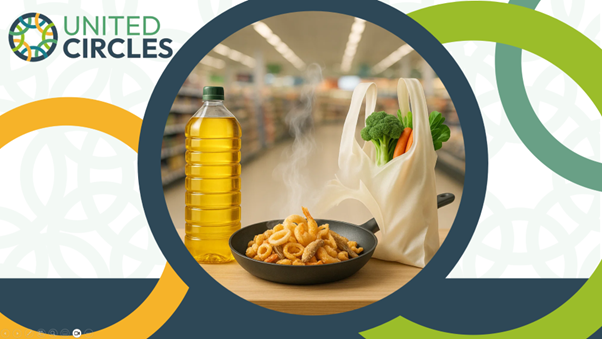
Every day, millions of kitchens across Italy produce a small but significant by-product — used cooking oil (UCO). It is what remains after preparing a fragrant fritto misto di pesce or other favorite dishes, something most people pour away without a second thought. Too often, this oil ends up down household drains, clogging pipes and polluting waterways; other times it is simply disposed of as non-recyclable waste. Yet this humble liquid, which once sizzled in a pan, holds extraordinary potential. What if the same oil, as well as other valuable byproducts, could be transformed through an innovative process into sustainable materials used in the very packaging we handle every day at the supermarket? This is precisely the vision that drives the Veneto Hub for Circularity.

Situated in the Veneto region — the wider territory of Venice, renowned for its centuries-old blend of craftsmanship and innovation — the Hub demonstrates how familiar daily gestures can be reconnected with advanced industrial ecosystems. At the center of this collaborative effort stands Novamont, one of the international players in the field of bioplastics and the development of bioproducts and biochemicals. up and biotechnological processes. that turning renewable resources into new materials. Alongside Novamont, the public owned waste-management company Contarina, among Europe’s most efficient circular operators, and Legacoop, Italy’s largest association of cooperatives, contribute their deep local roots and long experience in sustainable community-based enterprise. Sherpa Srl, a spin-off of the University of Padua, supports the initiative with technical coordination and systemic design expertise, ensuring that cooperation among industrial, public and civic actors remains cohesive and forward-looking.
Together, these partners pursue a clear and compelling mission: to close the loop on used cooking oils. Instead of treating this everyday residue as waste, the Hub aims at transforming it into everyday products such as bio-based films for sustainable food packaging — thin, high-performance biomaterials that could one day wrap the products found in every kitchen cupboard or supermarket shelf. In this way, the oil once used for frying seafood may return to households in the form of sustainable packaging, completing a tangible circle of value. The Veneto Hub thus reminds us that circularity does not begin in laboratories or factories, but in our own kitchens.
Yet this initiative is more than a technological experiment; it is a living model of urban-industrial symbiosis, where cities, industries and citizens collaborate to minimise waste and maximise shared benefits. The Veneto Hub functions as an evolving ecosystem of enterprises, utilities, public authorities, research centers and cooperatives, interlinked through a dense web of collaborations that cross traditional boundaries. It operates much like a new-generation industrial district, sustained by win-win partnerships that balance economic competitiveness with environmental responsibility.
Smart Technologies Driving the Transformation
Behind the Veneto Hub’s vision lies a sophisticated combination of science, engineering and collaboration. Transforming a kitchen residue into a high-performance biomaterial requires an entire chain of innovation — from collection and purification to bioconversion and product design. Each step is carefully developed and tested across laboratories, pilot plants and industrial sites in the region, ensuring that every drop of used cooking oil can be turned into something of new and lasting value.
The journey begins with collection and management, led by Contarina, the public utility responsible for waste services across large parts of Veneto. The company is refining how used cooking oils are gathered from households, restaurants and local businesses. Dedicated collection campaigns are being planned during village festivals and community events, making it easier for citizens to contribute directly to the circular economy. Samples from recycling centers and commercial kitchens are analysed to understand their composition, guiding improvements in purification and processing.
Once collected, the oils move to the biotechnology and chemistry laboratories of Novamont, where they are pre-treated, purified and prepared for transformation. Here, researchers are designing multi-feedstock biorefineries capable of converting these diverse oils into the chemical “building blocks” used to make new materials. Through advanced fermentation and catalytic processes, the feedstock is turned into monomers and bio-polymers that can be used to produce biomaterials and bioplastics for sustainable food packaging.
To achieve this, scientists are also exploring how to recover valuable by-products and fractions that can be further valorised into intermediates that can be fed back into the process, reducing both waste and energy consumption, and soil improvers such as biochar and bio-stimulants which can improve soil health and support regenerative agriculture.
These technological advances are accompanied by a strong focus on scale-up and industrial feasibility. Laboratory insights are being transferred to pilot-scale reactors and industrial demonstrators, ensuring that what works in research can thrive in real economic conditions. The Veneto Hub thus acts as a bridge between science and production — testing, adapting and validating each process until it can stand on its own in the marketplace.
Finally, the transformation is not only technological but also organisational. The Hub operates as a living system of collaboration among public utilities, cooperative enterprises and industrial innovators. Legacoop is mapping cooperative companies that generate or manage used oils, identifying those ready to join the circular value chain. By connecting these local actors, the Hub builds the infrastructure of a new regional bioeconomy — one that values waste, rewards participation, and demonstrates that sustainability can emerge from ordinary life, supported by extraordinary technology.
Real Impact on a Circular Future
The work of the Veneto Hub is not simply a scientific exercise — it is a concrete demonstration of how innovation can generate visible, everyday benefits for people and the environment. Each action carried out within the Hub contributes to making circularity a lived reality rather than an abstract goal.
- Preventing environmental damage at the source. By collecting and properly managing used cooking oils, the Hub helps prevent them from being poured into household drains, where they can clog sewage systems, pollute waterways and increase the cost of wastewater treatment. Each liter recovered represents both a saved resource and a reduced environmental burden.
- Turning waste into new materials with purpose. The oils collected across the Veneto are transformed into renewable building blocks for bio-based and biodegradable materials. Among the most promising applications are thin films for food packaging, and sustainable solutions for agriculture. These new materials can be disposed of in the organic waste collection and sent to composting facilities helping to reduce pollution in rivers and seas.
- Lowering the carbon footprint of everyday products. By replacing virgin feedstocks with renewable resources already available within local communities, the Hub contributes to reducing greenhouse gas emissions associated with material production and transport.
- Demonstrating a new model of circular symbiosis. The Veneto Hub shows that urban and industrial systems can work together, transforming what one sector discards into what another requires. This principle — cities feeding industries with renewable inputs — illustrates the broader promise of industrial-urban symbiosis.
- Producing sustainable alternatives for agriculture. Some of the by-products from the biorefinery process are being developed into mulching films and organic fertilisers, natural bio-alternatives to conventional products that are often more polluting and manufactured far from their place of use. This helps shorten supply chains and supports a more regenerative approach to agriculture.
The Veneto Hub’s impact lies in shaping a smarter, cleaner and more interconnected regional system — one that protects natural resources, reduces infrastructure costs, and ensures that waste from our kitchens can become raw material for a sustainable future.
Built for Replication
The Veneto Hub’s true value lies not only in its technological achievements, but in what it proves possible. While the specialised equipment and biotechnologies developed here may not be easily transferred to regions lacking similar infrastructures, the model of collaboration certainly can.
What the Hub offers to other territories — in Italy, Europe and beyond — is a tested method for coordination among public utilities, industries, cooperatives and research bodies, showing how urban and industrial systems can work in symbiosis. Equally replicable are the awareness actions that involve citizens and local communities in the circular economy, from collection campaigns to educational initiatives.
By documenting its environmental and socio-economic impacts, the Veneto Hub provides tangible evidence that connecting urban waste streams with industrial innovation is both feasible and advantageous. These lessons will feed directly into the wider United Circles network, helping other regions to design their own circular ecosystems and follow the path opened in Veneto.
Looking Ahead
The Veneto Hub will pave the way toward industrial application and validate the technical and environmental performance of bio-based materials derived from used cooking oils and other side-streams, ensuring that the processes developed can operate efficiently and sustainably at scale.
At the same time, the Hub will continue to involve local stakeholders — municipalities, cooperatives, companies and citizens — in awareness and participation activities, strengthening community engagement and sharing the results of this pioneering experience across the region.
Within the broader framework of United Circles, the Veneto initiative stands as one of the demonstrator Hubs, working alongside mirror and seed Hubs in other countries to test, adapt and replicate circular solutions. We invite readers, professionals and institutions to explore the project, follow its progress and take part in building Europe’s next generation of circular, symbiotic regions.
Written by Veneto Hub
 UNITED CIRCLES project has received funding from the European Union’s Horizon Europe programme under Grant Agreement No. 101178798.