On 24 February 2026, the PeCATHS project coordinator, Universitat Jaume I (UJI), participated in the OHPERA project’s Final Clustering Workshop: “From Novel Materials to Solar Hydrogen Futures: Scaling Up Circular Innovation in Europe.” Held at Hotel Primus in Valencia, this full-day hybrid event gathered researchers, industry leaders, policymakers, and innovators to explore the future of green hydrogen and sustainable chemistry.
Jose A. Mata from UJI (Universitat Jaume I) had the opportunity to present the progress of our PECATS project in an oral talk during session 2 “Renewable Hydrogen and potential symbiosis: Latest Research Highlights”.
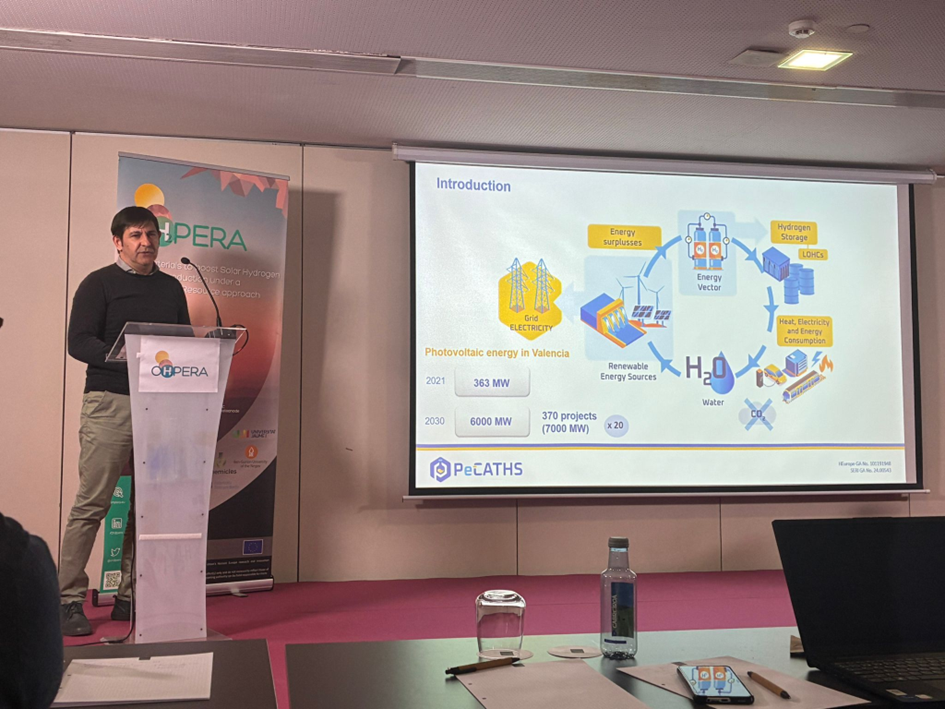
Presentation of the PeCATHS project by Jose A. Mata
Under the title of “Photo-electrocatalytic routes for long-term sustainable hydrogen storage” Jose A. Mata explained to the attendees PECATS project aims to develop an integrated long-term energy storage system using hydrogen in LOHCs, combined with innovative biomass conversion. This approach will enable the direct transfer of hydrogen from biomass to LOHCs without gas production and generate high-value chemicals, enhancing both sustainability and efficiency. The project uses biomass as a hydrogen source and solar power as a renewable energy source, simplifying integration and reducing costs compared to conventional systems. It addresses the urgent need for sustainable energy storage, transport and distribution.
The session also featured the FREEHYDROCELLS and FLOWPHOTOCHEM projects. While not direct “sister projects,” significant technical synergies were identified, paving the way for future complementary research.
Participants examined the role of advanced materials research and circularity in reinforcing value chains for large-scale clean energy deployment. The event served as a collaborative forum for academia and industry to align on Europe’s energy transition goals. These high-level exchanges successfully identified partnership opportunities, strengthening the cross-border cooperation necessary to advance solar hydrogen technologies.
Attendees at the clustering event
Establishing synergies with other European projects is a key strategy that transforms individual research into a collective force. Some of the most prominent features of these synergies can be summarized as follows:
- Collaboration enables the exchange of technical advances, accelerating the development of different hydrogen technologies.
- Sharing data, methodologies, and infrastructure reduces redundant costs and ensures more efficient use of EU funding across the research spectrum.
- By linking the different stages of the energy transition—from materials research to large-scale deployment—synergies contribute to building a stronger and more integrated European supply chain.
- A united front of multiple projects carries more weight with policymakers, helping to define regulations and standards that promote the adoption of green hydrogen technologies.
- Collaborative events broaden the reach of the PECATHS project, attracting a wider audience of industry stakeholders and potential investors.
We are looking forward to carry on sharing knowledge and establishing fruitful synergies with related projects and professionals. Reach out if you consider we both can benefit from it!
 PECATHS project has received funding from the European Union’s Horizon Europe programme under Grant Agreement No. 101191948.