MATSUS (Materials for Sustainable Development Conference) took place on 23rd-27th of March 2026 at the World Trade Centre, Barcelona, and the PeCATHS project presented the work carried out during the first year of the project and the work to be carried out in the remaining time.
The conference explored how materials science and technology can drive sustainable development by meeting current global needs without compromising future generations’ needs. It featured a blend of basic multidisciplinary research and practical applications focused on energy efficiency and environmental protection. It consisted of a combination of symposia on basic and multidisciplinary science and applied symposia focused on Sustainable Development.
PeCATHS was represented by two oral presentations by Elena Mas and Francisco Fabregat, both members of the Universitat Jaume I (UJI – INAM), the project’s coordinator.
Both oral presentations were part of the program E1, Breaking New Bonds: Electrocatalysis for Emerging Transformations.
Identification of Charge Transfer Centers in Biomass Transformations
On Tuesday, March 24th, Francisco Fabregat gave his presentation entitled “Identification of Charge Transfer Centers in Biomass Transformations”.
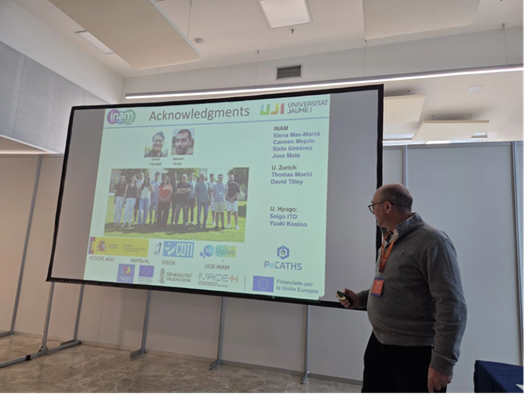
This presentation explored the application of impedance spectroscopy to identify charge states on electrode surfaces and examine how charge transfer is activated during the transformation of biomass-derived organic molecules.
The work presented focused on the study of reactions such as nitrobenzene reduction and the oxidation and reduction of hydroxymethylfurfural, and how these can be combined with hydrogen storage. It also showed how capacitance analysis can help identify surface coverage, reaction activation potentials, and absorption processes occurring on electrode surfaces, while charge transfer provides information on the process kinetics.
The presentation described a fundamental impedance spectroscopy methodology for the PeCATHS project, providing the kinetic and surface basis for biomass valorisation and hydrogen storage.
Electrocatalysis of Amine-Nitrile Systems: A Sustainable Path to Reversible Liquid Organic Hydrogen Storage
On Wednesday, March 25th, it was Elena Mas Marzá’s turn with her presentation on “Electrocatalysis of Amine-Nitrile Systems: A Sustainable Path to Reversible Liquid Organic Hydrogen Storage.”
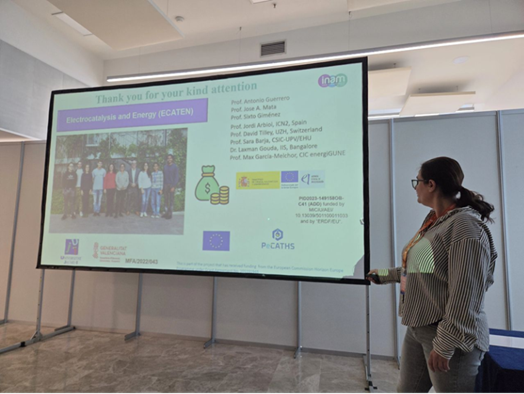
In her presentation, she highlighted the crucial importance of developing efficient technologies for hydrogen storage and transport and noted that liquid organic hydrogen carriers (LOHCs) represent a promising strategy. Traditionally, the hydrogenation (loading) and dehydrogenation (release) of LOHC pairs rely on expensive metal catalysts, often requiring high temperatures and pressures using molecular hydrogen.
In response to these challenges, a more sustainable approach using aqueous electrocatalysis is being explored. In this work, the reversible hydrogenation and dehydrogenation of an amine/nitrile pair under mild conditions were proposed, establishing this pair as a potentially efficient LOHC system. These advances collectively contribute to a reversible hydrogenation/dehydrogenation cycle, providing a viable, highly efficient, and potentially scalable solution for industrial hydrogen storage applications.
The proposed pathway is one of the key chemical routes investigated in the PeCATHS project to achieve a carbon-neutral economy, integrating electrocatalysis as the engine that links biomass transformation with efficient green hydrogen storage.
We congratulate both of them for their research efforts in this field and for sharing the achievements of the PeCATHS project with the rest of the scientific community.
 PECATHS project has received funding from the European Union’s Horizon Europe programme under Grant Agreement No. 101191948.