
As part of the SCENARIOS project, a series of in silico models has been developed and made available as ready-to-use web services through the Jaqpot platform. Special attention has been placed on reproducing literature-based Physiologically Based Kinetic models. The code for replicating the selected literature models can be found in the following GitHub repository: https://github.com/ntua-unit-of-control-and-informatics/PFAS_PBK_models. This repository contains R code for reproducing literature PBK model that describe PFAS biodistribution in multiple species. The list of available PBK models, which will be updated throughout the lifespan of the project, currently includes the following models:
- Humans:
- PFOS/PFOA (Loccisano et al., 2011)
- PFAAs (Fabrega et al., 2015)
- PFOS/PFOA (Fabrega et al., 2016)
- Rats:
- PFOA [male, female] (Loccisano et al., 2012, Worley and Fisher, 2015)
- PFOS [male, female] (Loccisano et al., 2012)
- PFHxS [male, female] (Kim et al., 2018)
- PFNA [male, female] (Kim et al., 2019)
- PFDA [male, female] (Kim et al., 2019)
- Fish:
- PFOS Rainbow trout PBPK (Vidal et al., 2020)
- PFAAs Protein Binding Fish PBK (Ng and Konrad Hungerbühler, 2013)
These models have been deployed as ready-to-use web applications on the Jaqpot platform (https://app.jaqpot.org). To use these web applications, access to the SCENARIOS organization is required. To obtain access, end-users should send an email to hsarimv@central.ntua.gr requesting permission to join the organization. Please note that to view the SCENARIOS organization on Jaqpot, you need to have been invited first.
Jaqpot is a computational platform developed by NTUA, that facilitates in silico modelling, by enabling the systematic production, collection, organization, validation, storage and sharing of predictive models, with emphasis on predictive toxicology. The Jaqpot graphical user interface (GUI) directs the model developers to further document their models in a way that can be easily understood and used by end-users with little or no experience on machine learning and statistical analysis. The GUI also allows the end-users to apply the models on their own data for validation and/or prediction purposes and the results are collected and visualised in automatically generated tables, graphs and reports. All major machine learning and statistical data-driven algorithms are supported in Jaqpot, by integrating popular libraries such as the Python Scikit-learn and the R Caret libraries. Jaqpot has been designed as a generic modelling and machine learning web platform, but particular emphasis is given on serving the needs of the chemo/bio/nano/pharma/ communities by integrating QSAR, biokinetics, dose-response and read-across models. Jaqpot has been developed by the Unit of Process Control and Informatics in the School of Chemical Engineering at the National Technical University of Athens.
An overview of the models that have been uploaded on the SCENARIOS instance in Jaqpot are presented in Figure 1.
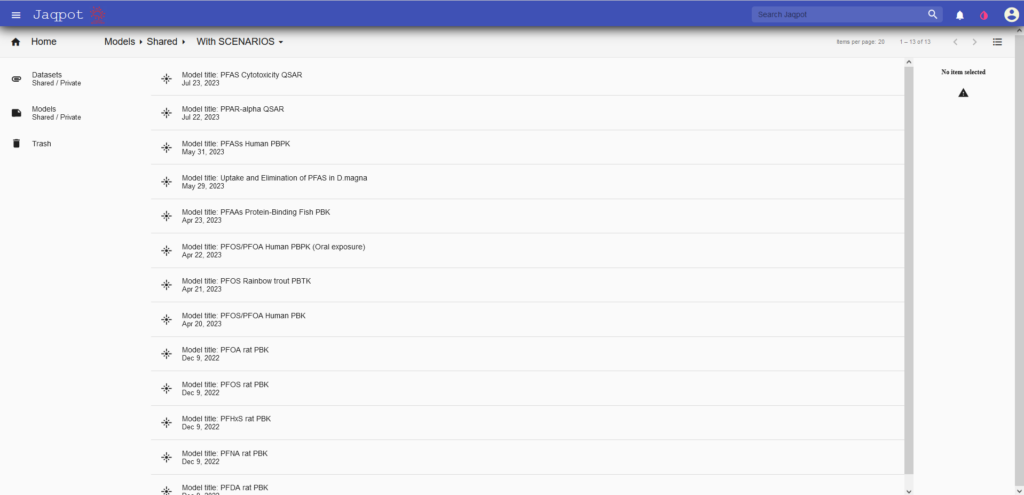
Figure 1: SCENARIOS models on Jaqpot
Briefly, the Jaqpot model GUI consists of 4 distinct tabs: “Overview”, “Features”, “Predict/Validate” and “Discussion”. A description of the model is available in the ‘Overview’ tab (Figure 2). End-users can see more details about the dependent and independent features of the model in the ‘Features’ tab (Figure 3).
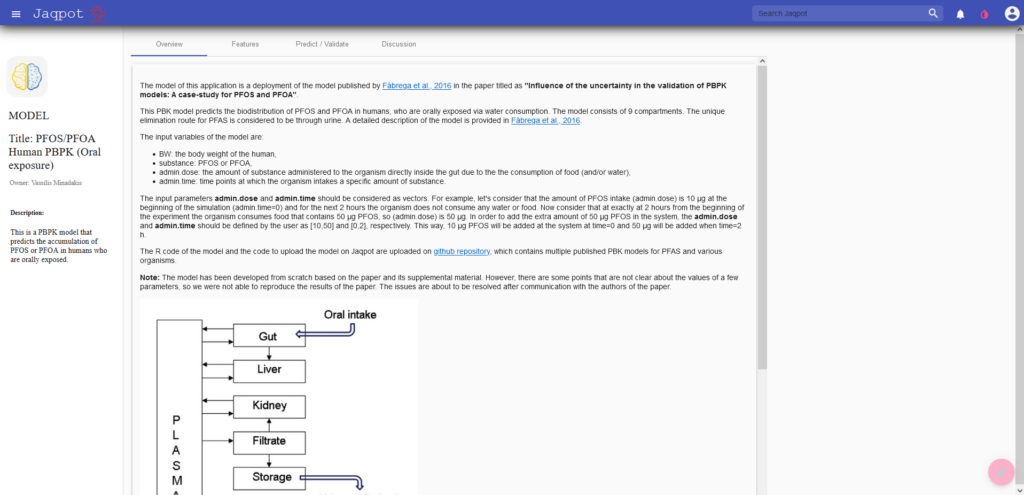
Figure 2: ‘Overview’ tab.
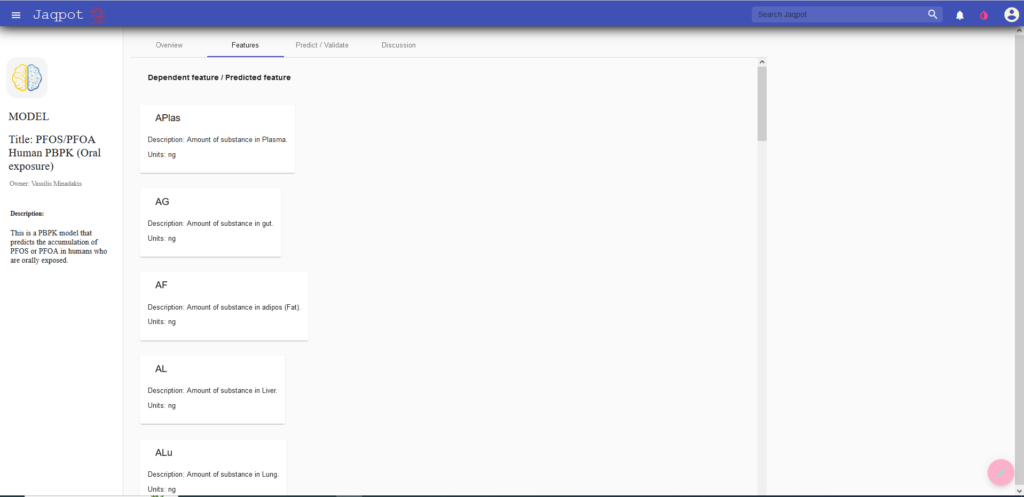
Figure 3: ‘Features’ tab.
In the ‘Predict/Validate’ tab end-users can provide an instance of the model (Figure 4), and acquire model predictions, which in the case of biokinetics/PBK models can be plotted using the plot module of Jaqpot (Figure 5).
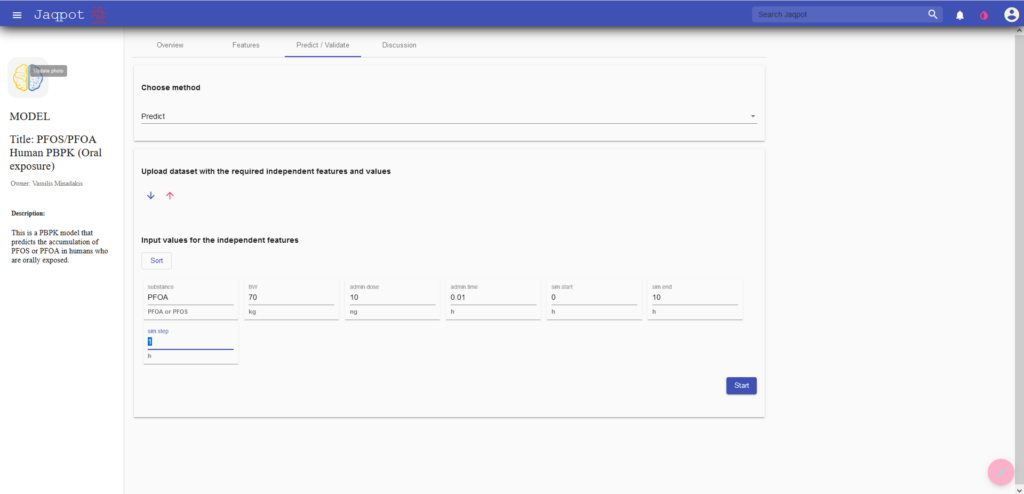
Figure 4: ‘Prediction’ tab.
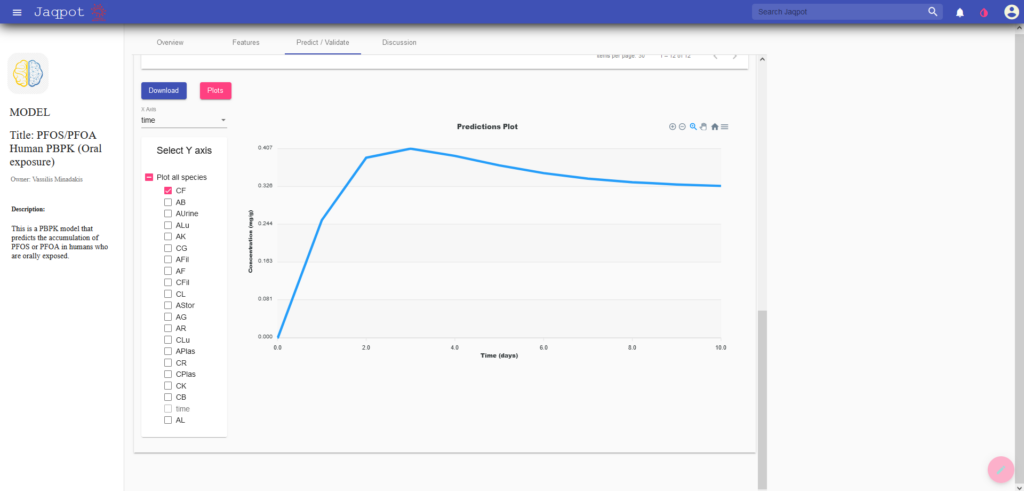
Figure 5: Concentration-time profile of a PBK model.
More information on how to use Jaqpot can be found in https://zenodo.org/communities/nanocommons?q=&f=subject%3ABiokinetics&l=list&p=1&s=10&sort=newest
 Scenarios project has received funding from the European Union’s H2020 programme under Grant Agreement No. 101037509.