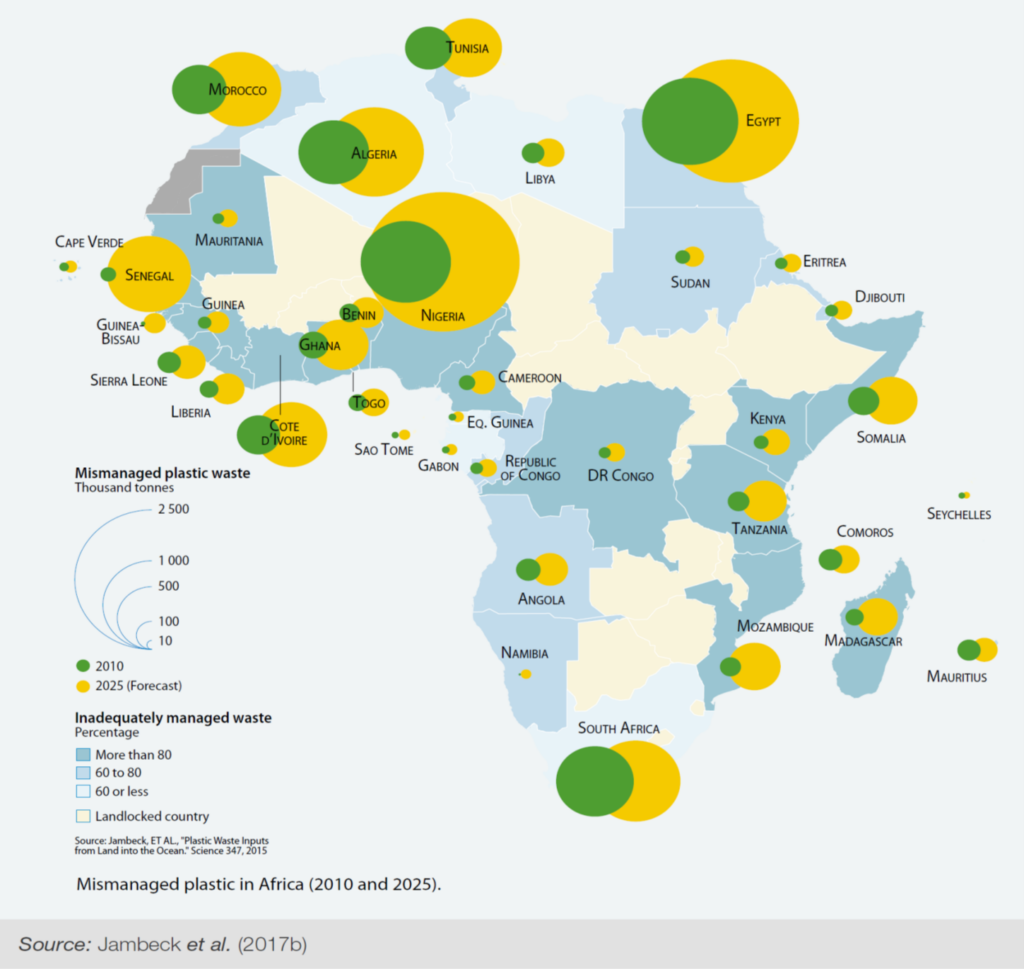
Africa’s experiencing the world’s highest rates of urbanization and population growth, along with rising material consumption and waste production[1] [2]. By the year 2050, Africa’s projected urban waste generation is expected to triple[3], creating both a significant environmental challenge and a considerable opportunity for circular innovation. Hence, Africa is key player in the global sustainability ecosystem. South Africa holds a distinctive strategic role. With an estimated economy of around USD 401 billion in 2024, South Africa ranks as one of Africa’s most developed and technologically sophisticated countries, significantly influencing the continent’s economic and innovation scene[4]. However, it is also grappling with ongoing sustainability issues, only 10% of the total waste produced in the country is recycled, resulting in the majority of material value being discarded in landfills[5]. Conversations at the United Nations Environment Assembly (UNEA‑7) underscored that Africa’s circular economy offers an estimated annual potential of USD 546 billion, with the ability to generate over 11 million jobs by 2030 in key sectors. The African Development Bank reinforced these statistics during its dialogue on circular economy policies[6].
The United Circles Gauteng Hub, Sustainability Hub for Africa, is an opportunity to embed circularity in Africa by developing local innovation capabilities, integrating systems, and establishing demonstrator platforms that bridge the gap between research and practical application. Sustainability Hub for Africa, led by Professor Arnesh Telukdarie from the University of Johannesburg, blends academia with extensive industrial expertise ranging from systems design and optimization projects in the manufacturing, mining, water, and infrastructure sectors in cooperation with businesses, governments, and organizations like UNIDO. This combination of theoretical and applied knowledge with the foundation of systems thinking ensures a holistic view, Africa a global influencer and Africa being influenced by the globe. This guarantees that the hub operations are well aligned with the United Circles’ priorities for deployment, scalability, and impact.
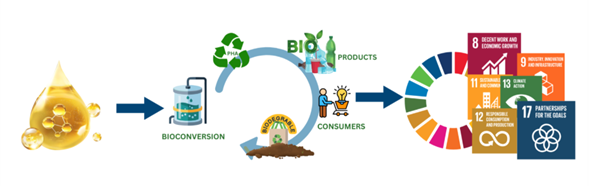
The Sustainability Hub for Africa integrates global circular economy frameworks tailored to South Africa’s socio-economic context, developing strategies for waste recovery and circular design while adopting best practices to address local challenges, such as informal economies and spatial inequalities. The hub is built on various pillars, the main include localizing global circularity best practice, social inclusion, digital tools and support development, and waste recycling/upscaling. Africa is the next frontier in sustainability, as demonstrated by our motto, “Where waste becomes wealth and innovation becomes opportunity,” with South Africa the gateway.
Written by Gauteng Hub
[1] World Bank (2018). What a Waste 2.0, https://datatopics.worldbank.org/what-a-waste/
[2] UNEP (2021). From Pollution to Solution: A Global Assessment of Marine Litter and Plastic Pollution, https://www.unep.org/resources/pollution-solution-global-assessment-marine-litter-and-plastic-pollution
[3] African Union Development Agency — NEPAD. (2021, July 19). What a waste: Innovations in Africa’s waste material management. AUDA-NEPAD. https://www.nepad.org/blog/what-waste-innovations-africas-waste-material-management
[4] World Bank. (n.d.). South Africa – Country profile. The World Bank. Retrieved January 27, 2026, from https://data.worldbank.org/country/south-africa
[5] Statistics South Africa. (2018, September 5). Only 10% of waste recycled in South Africa. Retrieved January 27, 2026, from https://www.statssa.gov.za/?p=11527
[6] African Development Bank. (2026, January 7). African Development Bank champions circular economy as Africa’s pathway to sustainable industrial growth at UNEA‑7. African Development Bank. Retrieved January 27, 2026, from https://www.afdb.org/en/news-and-events/african-development-bank-champions-circular-economy-africas-pathway-sustainable-industrial-growth-unea-7
 UNITED CIRCLES project has received funding from the European Union’s Horizon Europe programme under Grant Agreement No. 101178798.