
Storing solar hydrogen in liquid organic carriers
Producing hydrogen from renewable electricity is only half of the challenge. Storing and transporting it in a safe, energy-dense form is the other half, and it is where conventional approaches struggle. Compressed H2 gas requires high pressures, cryogenic liquefaction requires cooling to below -253 °C, and both add significant energy penalties on top of the hydrogen generation step itself. Liquid organic hydrogen carriers (LOHCs) offer a different route: hydrogen is bound chemically to an organic molecule, transported as a stable liquid at ambient conditions, and released catalytically at the point of use. The system is fully reversible, and the carrier molecule can be re-hydrogenated many times.
Nitriles are one of the most attractive LOHC classes. The reduction of a nitrile group (C≡N) to a primary amine (CH2-NH2) stores two equivalents of H2 per molecule, and the reverse dehydrogenation regenerates the nitrile cleanly. The benzonitrile to benzylamine couple is the model system we work with. Both molecules are liquid at room temperature, the reaction is thermodynamically well-defined, and copper has been shown to catalyze it selectively under purely electrochemical conditions as reported by our project-partner from INAM.
Rather than driving this reaction with grid electricity, we drive it with sunlight directly at a photocathode. A photocathode is a semiconductor electrode that absorbs light, generates electron-hole pairs, and uses the photogenerated electrons to reduce a target molecule at its surface. Doing this photoelectrochemically has three concrete benefits over conventional electrolysis coupled to a photovoltaic panel. It eliminates the electrical wiring, power electronics, and conversion losses between a separate PV module and an electrolyzer. It integrates light absorption and catalysis into a single device, which simplifies the system. And it opens the door to solar-driven chemical manufacturing at ambient temperature and pressure, without any external electrical input.
The chemistry at the photocathode, however, is more difficult than it looks. The reduction of benzonitrile to benzylamine proceeds through a reactive imine intermediate that is easily hydrolyzed by water to the corresponding aldehyde. The aldehyde is then reduced to benzyl alcohol, which is not part of the reversible hydrogen storage cycle and represents a permanent loss of faradaic efficiency. In parallel, the hydrogen evolution reaction competes for the same photogenerated electrons and further reduces selectivity. Suppressing both of these side pathways is the central catalytic challenge on the cathode side, and it dictates almost every material choice we make.
Our approach starts from cuprous oxide (Cu2O) as the light absorber. Cu2O has a bandgap of around 2.0 eV, is a p-type semiconductor, and can be produced by simple thermal oxidation of copper foil. On top of the absorber, we build a functional stack by atomic layer deposition: a thin Ga2O3 layer acts as an electron-selective contact and improves charge separation and the generated photovoltage, while a TiO2 layer protects the underlying material from the electrolyte during operation and conducts the photogenerated electrons to the interface. The copper catalyst on the electrolyte-facing surface is grown by photoelectrodeposition, which places catalyst material precisely where the cathodic photocurrent is generated. This self-selective deposition produces high-surface-area copper structures that maximize catalytic activity per projected area.
One consequence of a highly active catalyst layer is that it becomes optically opaque before it becomes catalytically saturated. In a conventional front-illuminated geometry, this means the catalyst starves the absorber of light exactly when it should be enabling the reaction. Our solution is backside illumination: light enters through the rear of the device, and the front surface is left completely free for catalyst deposition. This decouples the two roles that the front surface would otherwise have to share, and it removes an important design constraint. Backside illumination brings its own requirements though. The absorber must be thin enough that photogenerated carriers can reach the collecting contact within their diffusion length, and the rear contact must be simultaneously transparent, conductive, and hole-selective. The latter point is where things get interesting: p-type transparent conducting oxides are notoriously rare compared to their n-type counterparts, and finding a suitable material that is also compatible with our brittle free-standing Cu2O foils is an ongoing effort. Current candidates include NiO family oxides, ALD-grown Cu-Cr-O layers, and solution-processed hole conductors such as CuSCN and CuI.
Combining hydrogen storage with biomass upgrading
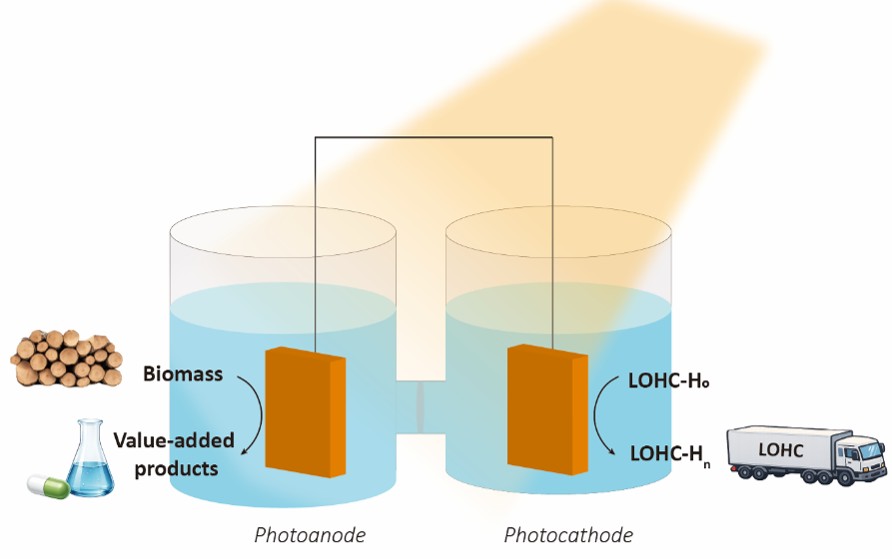
Solar-driven hydrogen storage in an LOHC is a compelling half of a solar chemistry system, but only a half. Every photocathode needs a paired photoanode, and the choice of oxidation reaction at that anode determines both the overall energy balance and the economic value of the process. The default choice, water oxidation, has fundamental drawbacks that motivate looking for alternatives.
The oxygen evolution reaction (OER) is widely regarded as the bottleneck of electrochemical energy conversion systems because of its sluggish reaction kinetics and the high overpotential required to drive the reaction. For this reason, replacing OER with alternative oxidation reactions has emerged as an attractive strategy. Among the various alternatives, biomass oxidation has gained considerable attention as a sustainable strategy for converting low-value and often discarded biomass-derived feedstocks into high-value chemicals, thereby contributing to a circular carbon economy.
Compared with OER, biomass oxidation offers several attractive advantages. Most importantly, it enables the production of value-added chemicals rather than low-value oxygen gas, improving the overall economic viability of the process. In addition, biomass oxidation generally requires a much lower overpotential than OER, reducing the energy input for electrochemical conversion. By utilizing waste biomass as a carbon source, it also contributes to carbon circularity and more sustainable chemical manufacturing. Furthermore, suppressing oxygen evolution can mitigate safety concerns associated with H2/O2 mixtures in large-scale hydrogen production systems.
Despite its great potential, several challenges must be overcome before biomass oxidation can be widely implemented in practical applications. One of the key challenges is the structural complexity of biomass-derived molecules. Because biomass-derived molecules contain multiple carbon atoms and several reactive functional groups, they can undergo numerous competing reaction pathways during the oxidation. While this complexity enables the production of a wide range of valuable chemicals, it also leads to complex product mixtures, increasing the cost and difficulty of downstream separation and purification. Therefore, developing highly selective catalysts that can direct biomass oxidation toward a desired product is essential for the commercialization of this technology. From a commercial perspective, the development of large-area electrodes capable of operating at high current densities is also critical to achieve rapid production rates and high product yields. Achieving both high catalytic activity and scalability will be crucial for translating biomass oxidation technologies from laboratory research to industrial applications.
To address these challenges, our research focuses on designing high-performance photoanodes for photoelectrochemical (PEC) biomass oxidation. First, we engineer photoanodes with an appropriate bandgap for effective solar energy harvesting. By incorporating multiple functional layers, including electron-selective layers, we enable efficient charge separation while facilitating rapid charge transfer. Second, we design the photoanode for backside illumination. This configuration leaves the front surface available for catalyst deposition, allowing a wider range of catalysts to be integrated while maintaining strong light absorption. As a result, the system offers a versatile strategy for developing efficient and scalable PEC biomass oxidation systems.
Ultimately, our goal is to integrate the PEC LOHCs reaction system with biomass oxidation to establish a solar-driven chemical conversion system. Unlike conventional water splitting, where oxygen evolution at the anode limits overall efficiency and economic value, this approach enables the production of valuable chemicals at both electrodes: hydrogen storage in a liquid organic carrier and selective upgrading of biomass-derived molecules. This strategy represents a promising route toward sustainable and practical solar fuel and chemical production.
Written by Jason Gerke, Nayeong Kim, Thomas Moehl, David Tilley (UZH)
 PECATHS project has received funding from the European Union’s Horizon Europe programme under Grant Agreement No. 101191948.