The Strasbourg Convention & Exhibition Center hosted one of the most ambitious scientific events of the year: the E-MRS Spring Meeting 2026.
Under the direct coordination of the European project PeCATHS consortium, the Symposium K of this event has consolidated itself as an epicenter of the debate on the ecological transition. This meeting brought together hundreds of scientists, technologists and industrial representatives with a common urgent goal: to design and accelerate the implementation of clean technologies to produce green hydrogen and high-value chemicals without resorting to fossil fuels.
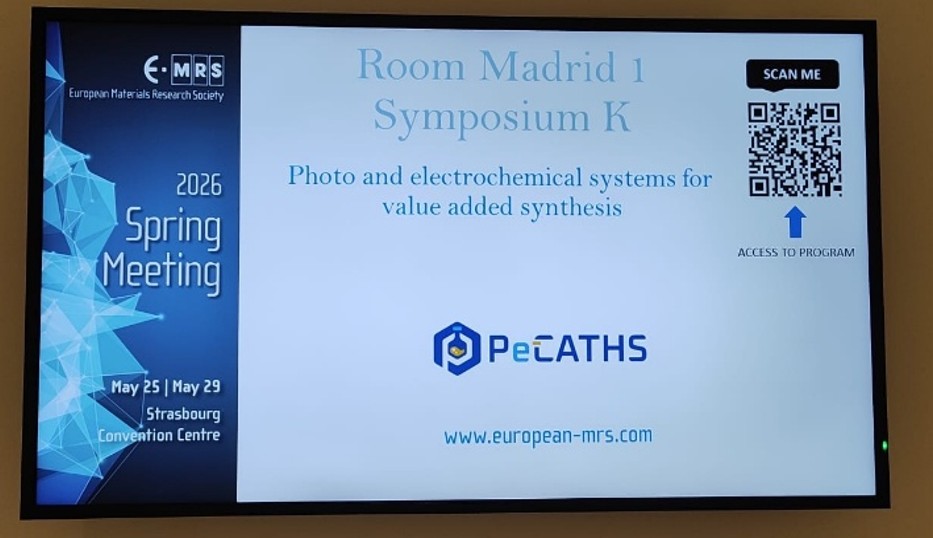
The scientific program designed by the PeCATHS team has successfully broken traditional barriers in research, masterfully connecting the most advanced theoretical simulations with laboratory-scale experimentation. Thanks to a panel of leading international speakers, attendees have been able to learn firsthand about solutions designed to address climate change.
The sessions of this symposium focused mainly on Liquid Organic Hydrogen Carriers (LOHC), a technology that uses organic compounds to store hydrogen in a safe liquid medium, facilitating its long-term storage and enabling transport through existing conventional fluid networks and pipelines, thus solving one of the major logistical problems of green energy.
Some of the most outstanding presentations related to the PeCATHS project within the K symposium (Photo and electrochemical systems for value-added synthesis) were:
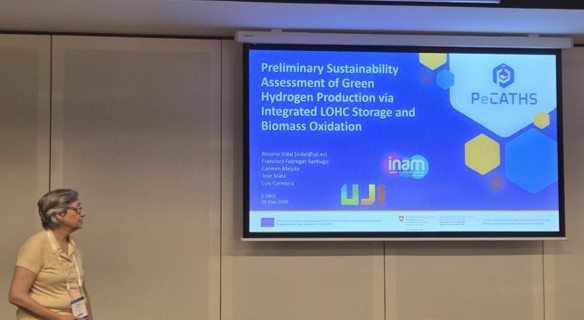
- “Preliminary Sustainability Assessment of Green Hydrogen Production via Integrated LOHC Storage and Biomass Oxidation” by Rosario Vidal (INAM/UJI). Presentation focused on sustainability assessment studies of new devices and processes.
- “Thermally Oxidised Cuprous Oxide Photocathodes for Selective LOHC Reduction” by Jason Gerke (UZH). Presentation focused on exploring the application of thermally oxidised Cu sheets as scalable, high-quality photoabsorbers for the selective reduction of liquid organic hydrogen carriers (LOHCs), with benzonitrile as a model substrate.
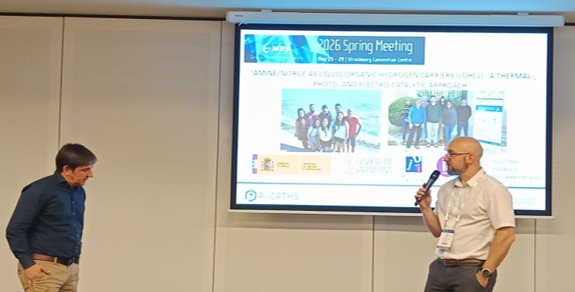
- “Amine/Nitrile as liquid organic Hydrogen carriers (LOHCs): a thermal-, Photo- and Electro-Catalytic Approach” by Jose A. Mata (INAM / UJI), who contributed with his experience in organometallic molecular catalysts coupled to solid supports.
- “Electrochemical transformation of 5-Hydroxymethylfurfural into Value-Added Chemicals” presented by Carmen Mejuto (INAM / UJI), who told us about how converting biomass into useful chemicals through electrocatalysis is a sustainable and environmentally friendly alternative to traditional chemical processes.
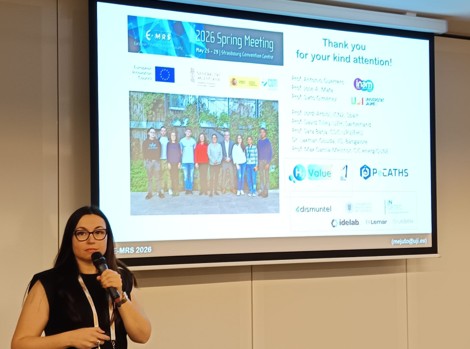
We would like to thank all the efforts of the symposium organizers:
Elena MAS MARZA, Institute of Advanced Materials, Universitat Jaume I
Alba GARZON MANJON, Catalan Institute of Nanoscience and Nanotechnology (ICN2)
David TILLEY, University of Zurich
Max GARCÍA-MELCHOR, CIC energiGUNE
Other contributions from PeCATHS to the eMRS Spring Meeting
Apart from organising the symposium K, members of the PeCATHs project also made their contributions in other sections of the convention:
- Symposium G “Future photovoltaics based on earth-abundant materials II” Professor Jordi Arbiol (ICN2) presented “Automated Atomic Scale STEM Data Analysis and Modelling for Energy Materials”, where he spoke about the identification of technological needs in the optimisation and application of new materials.
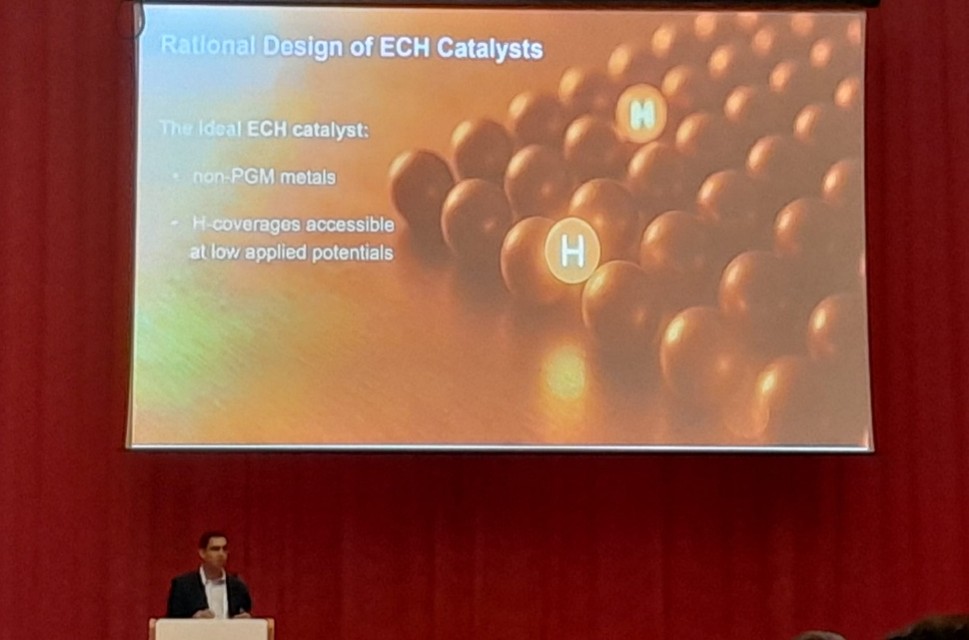
- Symposium J “NanoMaterials for Energy applications”. Max García-Melchor (CICenergiGUNE) presented “Tailoring electrified interfaces for selective electrochemical hydrogenation on earth-abundant metals”, demonstrating that electrifying chemical synthesis is a key strategy for enabling a defossilised chemical industry, where electrosynthesis provides a sustainable route for biomass valorisation and selective organic transformations.
The future of science: recognition of young research talent
One of the most emotional, dynamic and crowded moments of the congress was the poster session, a space specifically designed for new generations of scientists to present their projects directly to a highly demanding international evaluation committee.
Within this category, two of the young collaborators at PeCATHS presented their proposals:
- Modelling of electrocatalysts towards long-term sustainable hydrogen storage by Eliza DEMPSEY
- Coupling Electrochemical Hydrogen Storage and Biomass Valorisation by Cristian BACHMANN
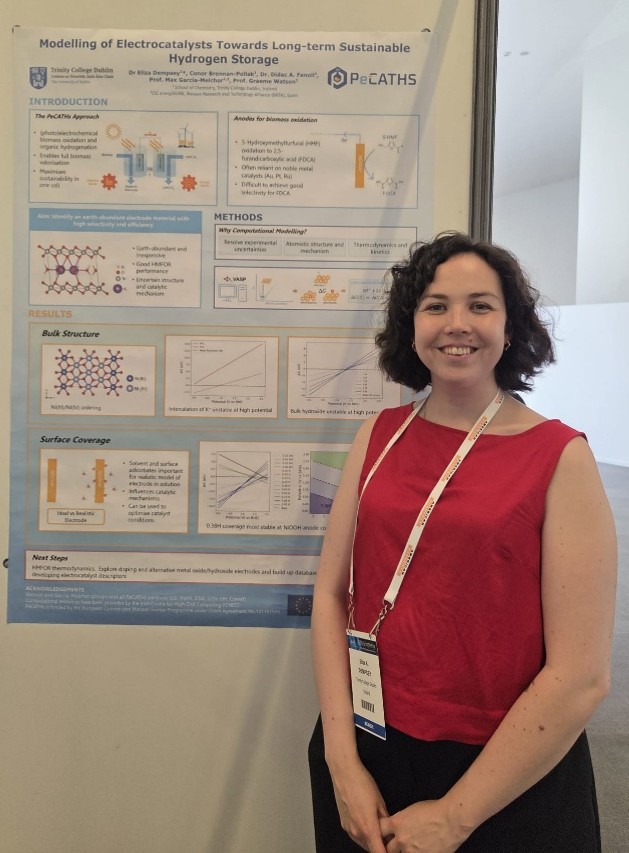
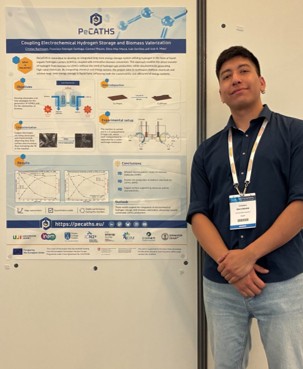
This year, the prestigious E-MRS Young Scientist Poster Awards have honoured disruptive research that paves the way for future commercial devices: Hybrid purification devices and Sustainability in rare materials.
A real impact that is born in Strasbourg and travels to the industry
The success of the Symposium K, organised by the PeCATHS consortium, highlights that transnational cooperation and EU funding are indispensable drivers to address the global climate emergency. The event included bilateral meetings with the private sector that will serve as a basis for the creation of new patents, spin-offs and immediate industrial applications. With the conclusion of this spring edition, the European scientific community takes a significant step towards achieving the Paris Agreement’s decarbonization goals by 2050.
 PECATHS project has received funding from the European Union’s Horizon Europe programme under Grant Agreement No. 101191948.